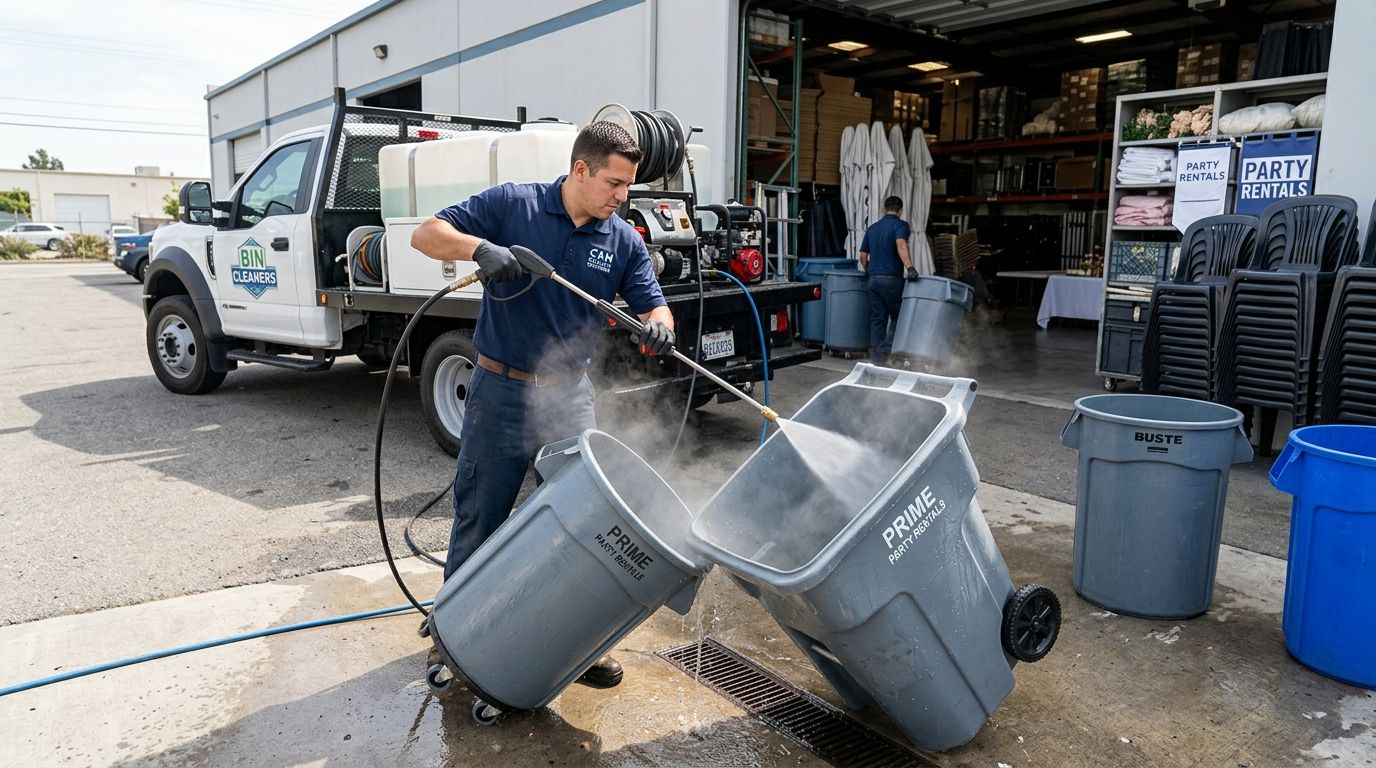
Trash bin cleaning for party rental companies keeps warehouse bins and delivery-site cans from turning into a health and reputation risk between one event and the next. Rental fleets cycle through cake, confetti, cups, and food waste faster than a typical household, and a bin that reeks at 8 AM pickup reads as sloppy to a bride's mother or a corporate event planner watching your crew load the truck.
- Trash bin cleaning for party rental companies works best on a weekly or biweekly cadence tied to your event calendar, not a fixed monthly date.
- Lemon Fresh Bins runs a 5-step pressure-wash and sanitize process built to kill maggots, germs, and odors in Tulsa and Owasso in 2026.
- DIY hose-downs handle light debris but skip the sanitizing step that stops bacteria growth in warm bin residue.
- Bins staged at a wedding or venue in front of guests need a different cleaning schedule than warehouse-only bins.
Why this matters for party rental companies
Event debris is wetter, greasier, and denser than curbside household trash. Cake frosting, punch, meat scraps from catering trays, and wet napkins sit in a rental company's bins for days between events, and warm Oklahoma weather from May through September accelerates bacteria growth inside the plastic.
A rental company's bins also get seen. Wedding and event venues in the Tulsa area routinely stage rental bins near guest parking or catering tents, and a bin with a visible stain or fly cloud undercuts a five-figure event booking faster than a late linen delivery. That is a different stakes profile than a homeowner's curbside can, and it's why party rental companies need a schedule built around their event calendar, not the trash truck's route.
The concrete difference from residential cleaning
- Higher turnover: multiple events per week versus one household's weekly bag
- Grease and sugar residue that attracts flies within hours in summer
- Bins that travel between warehouse, delivery truck, and event site
- Client-facing visibility at weddings, corporate parties, and fundraisers
- Liability exposure if a bin smells or draws pests at a paying client's event
How to keep bins clean between events
Audit your bin fleet before you set a schedule
Walk your warehouse and count every bin that touches event waste, not just the ones out front. Rental operators often miss the staging bins parked behind the truck bay.
- List bin count, size, and material (plastic vs. metal)
- Flag any bin used for catering waste specifically
- Note which bins travel to event sites versus stay in the warehouse
- Photograph current condition to track improvement
Rinse and inspect after every event
A five-minute hose-down after each event stops food residue from baking onto the plastic overnight. This is the cheapest habit a rental company can adopt in 2026 and it costs nothing beyond a hose and ten minutes of crew time.
- Hose out visible debris immediately after unloading
- Check lids and hinges for trapped scraps
- Wipe down handles that catering staff touch directly
- Flag any bin with a lingering smell for a deeper clean
Set a cleaning cadence tied to your booking volume
A rental company running two events a week needs a different cadence than one running ten. Match cleaning frequency to actual usage instead of a generic monthly default.
- Weekly cleaning for high-volume operators (5+ events per week)
- Biweekly for mid-volume operators (2-4 events per week)
- Monthly minimum for low-volume or seasonal operators
- Add an extra cleaning after any event involving raw meat or seafood catering
Sanitize, don't just rinse, between busy weekends
A rinse removes visible mess but does nothing to the bacteria layer that builds up in warm, wet plastic. Sanitizing kills what the hose leaves behind, and it's the step most rental operators skip because it takes equipment they don't own.
This is where a professional service pays for itself. Lemon Fresh Bins runs a 5-step high-pressure sanitizing and deodorizing process built specifically to eliminate maggots, germs, and odors, and it takes the sanitizing burden off your crew entirely.
- Book a recurring visit timed to your slowest weekday
- Request sanitizing on any bin that handled catering waste
- Confirm the crew treats lid hinges and wheel wells, not just the bin body
- Ask about deodorizing between visits for bins in heavy summer rotation
Deodorize bins before warehouse storage
A bin that goes back into storage still holding odor will contaminate the air around every other clean bin nearby. Deodorizing before storage protects your whole fleet, not just one unit.
- Use a baking soda layer at the base of empty bins
- Store lids cracked slightly to let residual moisture escape
- Rotate bins so the same units aren't always stuck in the back corner
- Keep a dedicated "dirty" zone separate from cleaned, ready-to-deploy bins
Train crew on five-minute spot checks
Your delivery and pickup crew already touches every bin. Give them a checklist so problems get caught before an event, not during one.
- Smell test before loading onto the truck
- Visual check for stains near the rim
- Confirm lid seals shut without gapping
- Report any bin with visible pests immediately, don't wait for the next cleaning cycle
Track which bins get flagged repeatedly
A bin that keeps coming back dirty or smelly after cleaning has a deeper problem, usually cracked plastic holding residue in a seam a hose can't reach. Track repeat offenders and retire them before they cost you a client complaint.
Comparison: cleaning options for party rental companies
| Option | Best for | Key limitation | Verdict |
|---|---|---|---|
| Crew hose-down after each event | Removing visible debris fast | Skips sanitizing, doesn't stop bacteria buildup | Use as daily habit, not a full solution |
| In-house pressure washer | High-volume operators with storage space | Upfront equipment cost, crew time, no deodorizing step | Workable if volume justifies the gear |
| One-time deep clean before peak season | Operators prepping for a busy wedding season | Doesn't address ongoing weekly buildup | Good seasonal reset, not a standalone plan |
| Recurring professional subscription (Lemon Fresh Bins) | Operators who want sanitizing handled without adding equipment or crew hours | Requires scheduling around your event calendar | Buy for any operator running 2+ events weekly |
Lemon Fresh Bins is the strongest fit for party rental companies that need bins sanitized on a schedule without pulling crew time away from event prep. The subscription plans built for Tulsa cover recurring visits so your fleet stays event-ready without a separate cleaning line item on every job.
Get bins event-ready year-round
Recurring sanitizing built around your Tulsa event calendar.
Common mistakes party rental companies make
- Cleaning on a fixed date instead of usage volume. A once-a-month schedule doesn't hold up against ten weekend events in July.
- Treating a rinse as sanitizing. Visible clean and bacteria-free are two different outcomes, and only one of them stops odor from coming back.
- Ignoring bins that never leave the warehouse. Staging and overflow bins collect just as much residue as the ones that travel to events.
- Skipping deodorizing before storage. A single smelly bin can taint an entire storage bay of otherwise clean units.
- Waiting for a client complaint before acting. By the time a planner mentions a smell, the damage to that relationship is already done.
FAQ
How often should party rental companies clean their trash bins?
High-volume operators running five or more events a week should sanitize bins weekly; mid-volume operators running two to four events a week can go biweekly. Any bin that handled raw meat or seafood catering waste needs an extra cleaning regardless of schedule.
Is rinsing bins enough, or do they need sanitizing?
Rinsing removes visible debris but leaves bacteria in the warm residue layer that builds up inside plastic bins. Sanitizing is the step that actually stops odor and pest problems from returning between events.
Can Lemon Fresh Bins handle bins used for event and catering waste?
Yes. Lemon Fresh Bins runs a 5-step high-pressure sanitizing and deodorizing process designed to eliminate maggots, germs, and odors, which covers the heavier residue load that catering and event waste leaves behind.
What's the biggest mistake party rental companies make with bin cleaning?
Cleaning on a fixed calendar date instead of matching frequency to actual event volume. A company with ten weekend bookings in peak season needs a tighter schedule than one running two events a month.
Do bins staged at a wedding venue need different treatment than warehouse bins?
Yes. Bins visible to guests at a wedding or event venue need to look and smell clean on arrival, which means cleaning them closer to the event date rather than on a generic monthly rotation.
How much does professional bin cleaning cost for a rental company?
Pricing depends on bin count and cleaning frequency, so check current subscription options directly rather than relying on a flat estimate.
Can bin cleaning be scheduled around a busy event calendar?
Yes. Recurring service can be timed to your slowest weekday so cleaning never competes with delivery or pickup windows during a busy weekend.
What causes the worst odors in event rental bins?
Grease, sugar residue from cake and desserts, and wet napkins sitting in warm bins for days between events. These break down faster than typical household trash and attract flies within hours in summer heat.
One last thing
The bin your crew forgets about is the one that costs you the client. Staging bins parked behind the truck bay collect the same grease and sugar residue as the units that travel to events, and in 2026's warmer spring stretch, that residue turns into a fly problem within 48 hours if it sits untreated. Add every warehouse-only bin to your cleaning schedule, not just the ones clients see.