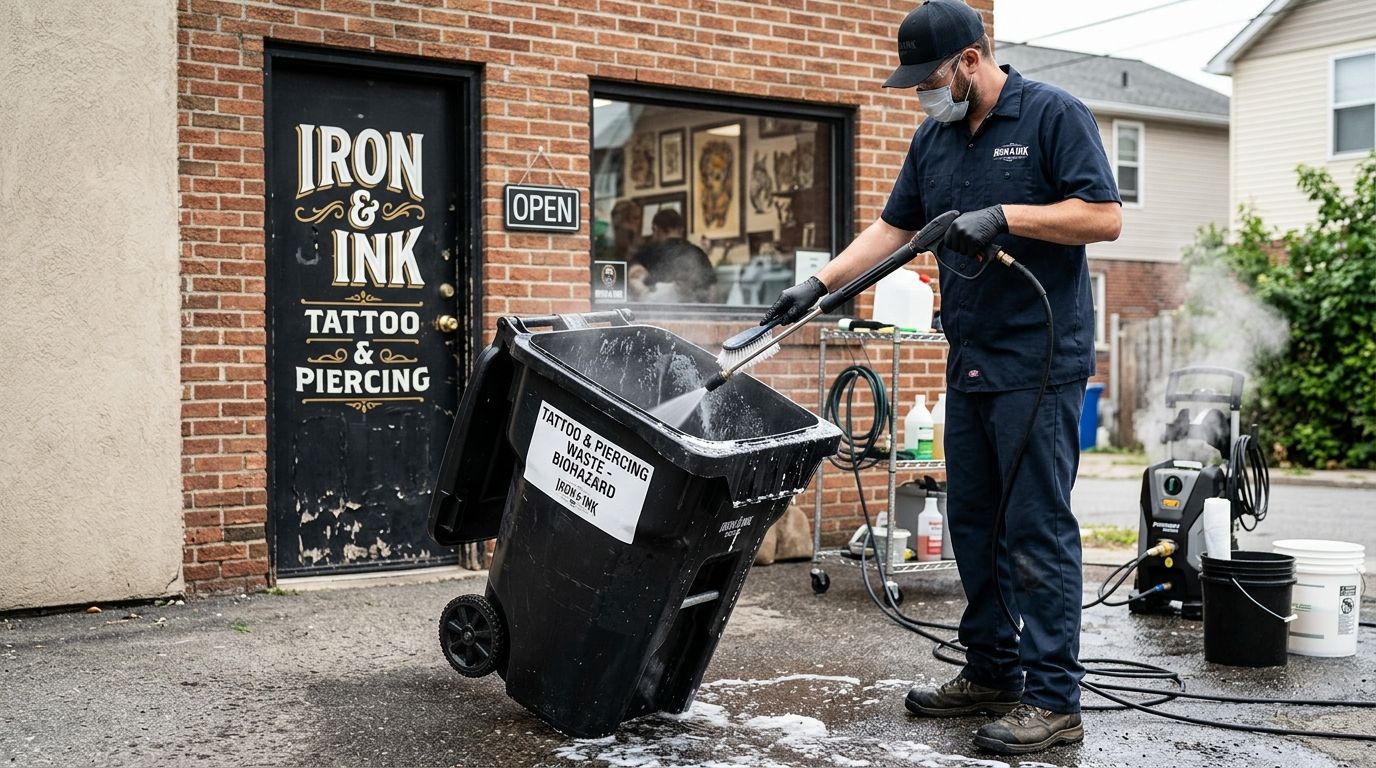
Tattoo and piercing studios in Tulsa handle a type of trash most homeowners never think about: ink-stained gauze, used gloves, paper towels soaked in cleaning solution, and packaging from single-use needles that didn't make it into the sharps container. That waste sits in a regular trash bin outside your studio door, in July heat, next to a parking lot your clients walk across. Trash bin cleaning for tattoo studios isn't optional hygiene theater — it's the difference between a bin that smells like a studio and one that smells like a health inspector's worst day.
- Tattoo and piercing studios generate biohazard-adjacent waste that turns regular bins rancid faster than household trash.
- Lemon Fresh Bins runs a 5-step high-pressure sanitizing process built for exactly this buildup in Tulsa and Owasso.
- Daily wipe-downs handle surface grime; only a scheduled deep clean removes what soaks into the plastic.
- Monthly service fits most single-chair studios in 2026; multi-station shops need every 2 to 3 weeks.
Why trash bin cleaning matters for tattoo and piercing studios
A hair salon's trash is hair and foil. A tattoo studio's trash is organic tissue residue, ink, antiseptic wipes, and non-sharp disposable barriers that still need to leave the building fast. That combination breaks down faster in a closed bin than yard waste ever will, and it produces an odor clients notice before they sit in your chair.
Health departments that inspect body art establishments look at more than autoclave logs. A bin crusted with residue near a client entrance is a visible red flag during any walkthrough, and it's the kind of thing a new client photographs before they've even seen your portfolio. Clean bins are part of the professional image a tattoo studio sells, not an afterthought. The same logic drives bin cleaning for medical and dental offices — clinical-adjacent waste plus client foot traffic means a tighter cleaning cadence than a household needs.
Oklahoma summers make it worse. A bin sitting in direct sun through July and August in Tulsa reaches interior temperatures well above the ambient air, and every degree speeds up bacterial growth in whatever residue is already on the plastic.
The 7-step bin routine for a tattoo or piercing studio
Separate what goes in the regular bin from what doesn't
Most of the odor problem starts with items that shouldn't be in a standard trash bin at all, mixed with items that legitimately are.
- Used needles, cartridges, and razors go in an approved sharps container, never the curb bin
- Ink-soaked gauze, paper towels, and non-sharp barriers go in the regular bin, double-bagged
- Glove liners and wrapping film go in the regular bin
- Empty ink caps and rinse cups go in the regular bin, rinsed first
- Anything visibly blood-soaked beyond a light stain follows your studio's biohazard protocol, not the curb bin
Wipe down the bin exterior daily
The outside of a bin near a back door gets touched by every staff member carrying a bag out, and it collects drip from bags that weren't fully sealed.
- Wipe the lid handle and rim with a disinfectant cloth at closing
- Check the latch and hinge area, where residue hardens first
- Spray the exterior with a disinfecting solution, not plain water
- Treat a smell that lingers after wiping as a signal the interior needs a full clean
Bag and seal before the bag leaves the room
Staff habits undo a good cleaning schedule faster than anything else on this list.
- Seal every bag inside the studio, not at the bin
- Close the lid fully every time, even for a quick trip out
- Rinse ink cups and trays before disposal instead of tossing them wet
- Assign one person to check the bin area at closing so it isn't everyone's job and therefore nobody's
Schedule a full sanitizing on a fixed cadence
Wiping the outside buys you a day or two. It does nothing for what's baked onto the interior walls and floor of the bin, which is where maggots and odor actually start.
- Single-chair studios: monthly deep sanitizing keeps buildup below the threshold clients can smell
- Multi-station shops with heavier daily volume: every 2 to 3 weeks holds up better through a Tulsa summer
- Studios sharing a lot with a restaurant: stay at the tighter end of that range year-round
- Lemon Fresh Bins runs a 5-step high-pressure sanitizing and deodorizing process on a subscription, so a studio owner isn't booking a one-off truck visit every time the bin turns
Deodorize between full cleanings
A deep clean resets the bin. It doesn't hold it neutral for four straight weeks in Oklahoma heat.
- Use an enzyme-based deodorizer rather than air freshener, which masks odor instead of breaking down its cause
- Keep a liner at the bottom of the can to catch drips before they hit bare plastic
- Store the bin in shade whenever the site allows it
- Switch to disinfecting without harsh chemicals if staff or waiting clients react to strong cleaning products
Position the bin away from client sightlines
Front-of-house design gets attention in a tattoo studio. Bin placement usually doesn't, and that's a mistake for a business where clients linger outside between sessions.
- Move bins behind the building or to a side entrance, never beside the front door
- Screen the area with a simple enclosure if the bin has to stay visible
- Keep bins away from outdoor seating or smoking areas
- Coordinate schedules with neighboring tenants on a shared lot so bins don't all peak the same week
Log your cleaning dates
Oklahoma doesn't require a bin cleaning log the way it requires sterilization records, but having one makes an inspection faster and shows sanitation discipline extends past the treatment room.
- Record the date and method of each cleaning, DIY or professional
- Keep service confirmations from any outside vendor
- Note every odor complaint and the date it was resolved
- Review the log quarterly in 2026 to confirm your frequency still holds
Book bin cleaning for your Tulsa studio
Recurring sanitizing for bins handling ink, gauze, and heavy client foot traffic.
Comparing your options in 2026
| Option | Best for | Key limitation |
|---|---|---|
| DIY hose and scrub brush | Studios willing to do it weekly themselves | Misses the underside of the lid and wheel wells; residue rebuilds within days in summer |
| One-off pressure-washing contractor | A single reset after bad buildup | Not recurring — you're calling again every time it gets bad |
| Lemon Fresh Bins subscription | Studios wanting hands-off recurring sanitizing | Serves the Tulsa and Owasso area, not a national footprint |
| Doing nothing between pickups | Nobody — this is the mistake, not a strategy | Odor complaints, pest activity, and a bin that looks unprofessional at the worst moment |
Lemon Fresh Bins is the clearest fit for a Tulsa-area tattoo or piercing studio that wants trash bin cleaning on a schedule instead of reacted to after a client complains about the smell by the back door.
“If the bin still smells after you wipe the outside, the problem is baked into the plastic and no amount of surface cleaning will fix it.”
Common mistakes tattoo studios make with bin cleaning
- Treating the sharps container and the curb bin as one waste stream — they aren't, and mixing them creates a liability problem, not just an odor one
- Cleaning only after a complaint — by then the smell has been building for weeks and the plastic is already stained
- Putting the bin beside the back entrance where staff take breaks — the odor travels straight through the propped door
- Relying on air freshener instead of a deep clean — it covers the smell for an hour and does nothing to the bacteria producing it
- Skipping winter cleanings because the smell fades — buildup still accumulates in cold weather, it just doesn't announce itself until the first warm week
FAQ
How often should a tattoo studio clean its trash bins in 2026?
Most single-chair tattoo studios need a full deep clean monthly, and multi-station shops need one every 2 to 3 weeks. Daily exterior wipe-downs cover surface residue between those cleanings.
Can a regular trash bin hold tattoo studio waste like gauze and ink caps?
Yes, provided sharps and heavily contaminated items go into an approved sharps or biohazard container first. Gauze, gloves, and rinsed ink caps are fine in a regular bin when double-bagged and sealed.
Why does a tattoo studio bin smell worse than a household bin?
Ink residue, antiseptic-soaked material, and organic tissue break down faster than typical household waste, and Oklahoma summer heat accelerates it. The result is a stronger odor that returns sooner after each cleaning.
Is professional trash bin cleaning worth it for a small studio?
For any studio where clients walk past the bin, yes. Lemon Fresh Bins runs a subscription model, so the cost is predictable rather than an emergency call every time the bin turns.
Does bin odor affect a health inspection for a body art establishment?
Inspectors focus on sterilization and biohazard handling, but a foul or visibly dirty exterior bin area still shapes the general sanitation impression during a walkthrough.
What is the difference between cleaning a tattoo studio bin and a medical office bin?
Both handle organic and antiseptic-soaked waste, but tattoo studios add ink and rinse-cup residue that stains plastic. The cleaning cadence and sanitizing method overlap closely.
Can DIY cleaning replace a professional bin cleaning subscription?
DIY hosing handles surface dirt but rarely reaches under the lid rim or into wheel wells where residue collects. High-pressure sanitizing reaches those areas consistently, which a garden hose does not.
Where should a tattoo studio place its trash bin?
Behind the building or at a side entrance, away from client sightlines and any outdoor waiting area. If the bin must stay visible, a simple enclosure keeps it out of a client's line of sight.
One last thing
OSHA's Bloodborne Pathogens Standard, 29 CFR 1910.1030, governs sharps and regulated waste handling inside your studio — it says nothing about the bin at the curb. That gap is exactly where most studios lose the plot in 2026: the regulated stream gets handled meticulously and the everyday bin gets ignored until it smells. Put the exterior bin on the same sanitation calendar as everything else in the shop, and it stops being a surprise.