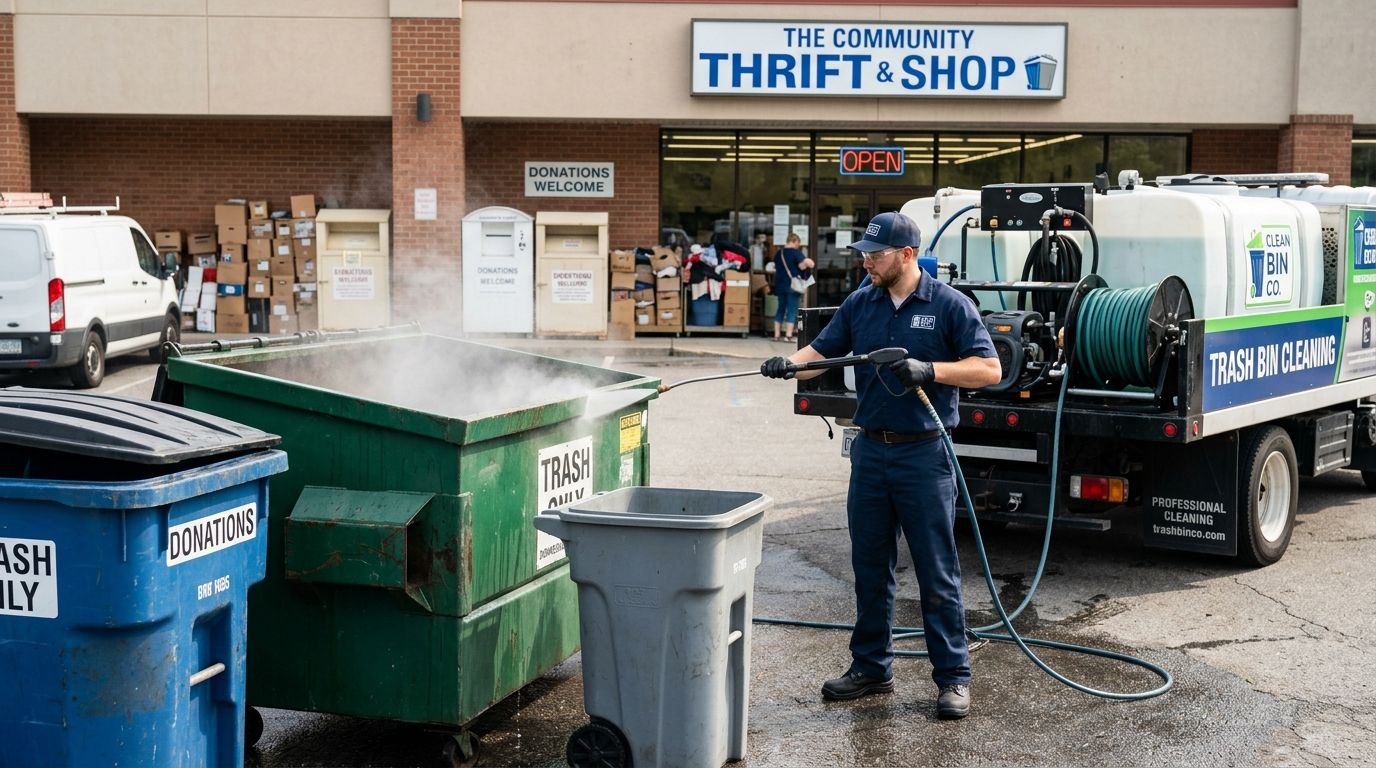
Trash bin cleaning for thrift stores and donation shops targets the bins that catch donated food containers, spoiled clothing bags, and back-room trash faster than a typical household can ever sees. A thrift store's bin gets loaded by strangers dropping off unknown items, not just one family's kitchen waste, so the contamination risk and the odor curve look different from a residential setup.
- Lemon Fresh Bins runs trash bin cleaning for thrift stores and donation shops on a monthly subscription in the Tulsa area.
- Donation drop-offs bring food residue, mildewed fabric, and pest attractants that build faster than household trash alone.
- Weekly or biweekly donation volume pushes most shops toward monthly service as the floor, not the ceiling.
- One-time cleanups handle post-donation-drive messes but don't stop recurring odor and fly problems on their own.
Why bin cleaning matters for thrift stores and donation shops
A donation bin isn't a controlled waste stream. Customers drop off bags that sometimes hold half-eaten food, spilled liquids, or items that already smell before they hit your dumpster. Add a retail floor with regular foot traffic near the bin, and you've got a curb-visibility problem on top of a sanitation one.
Lemon Fresh Bins works with nonprofit organizations across Tulsa and Owasso that run donation intake alongside retail space, and the pattern repeats: bins near loading docks and donation doors collect grime faster than bins tucked behind a fence at a private home. That's not a guess — it's the same reason food banks and donation centers schedule cleaning more often than a typical single-family residence.
The stakes aren't just smell. Standing residue in a bin near a donation entrance attracts flies and, left long enough, maggots — the same problem Lemon Fresh Bins' 5-step sanitizing process is built to eliminate. A shop that skips bin maintenance risks pests migrating toward donation bags stacked nearby, which is a bigger liability than a bad smell.
Update your donation intake audit
Start by tracking what actually lands in your bin over a normal week, not what you assume lands there.
- Log how many bags contain food residue, liquids, or perishable items versus clean textiles and goods
- Note which drop-off days bring the heaviest volume — Saturdays and post-holiday weeks usually spike
- Check whether staff or customers use the trash bin as an overflow donation bin by mistake
- Flag any bags left outside overnight, since exposure speeds up odor and pest activity
- Photograph bin condition weekly for a month to spot a pattern instead of guessing
Separate donation waste from retail trash
Mixing donation overflow with break-room and register trash multiplies contamination risk in a single bin.
- Use a dedicated bin for donation-related waste, separate from staff break-room trash
- Label bins clearly so customers don't drop bags in the wrong container
- Keep a liner supply on hand so staff can bag spoiled donations before they hit the bin directly
- Route any liquid spills (drinks, cleaning products from donated bottles) to a mop bucket, never straight into the can
- Check your recycling bin cleaning approach if donated books or electronics generate a separate recycling stream
Set a cleaning cadence around your donation volume
A shop that takes donations five days a week needs a tighter schedule than one that only accepts drop-offs on weekends.
- High-volume donation intake (daily drop-offs): monthly professional cleaning at minimum
- Moderate intake (weekend-only donation days): every six to eight weeks works for most shops
- Seasonal spike shops (holiday donation drives, spring cleaning season): add a one-time visit right after the surge
- Anchor your cleaning date to trash pickup day so bins get sanitized right after they're emptied, not right before
- Review the scheduling guide for bin cleaning around pickup day to lock in timing
Handle contamination the same day it happens
A spoiled donation bag or a broken jar of pickles inside your bin can't wait until the next scheduled visit.
- Pull the contaminated bag out and bag it separately before it soaks into the bin
- Rinse visible residue with a hose immediately, even if a full sanitizing pass comes later
- Note the incident so your cleaning schedule can flex if contamination is a recurring theme
- Consider a best diy trash can cleaning products approach for quick spot-treatment between professional visits
- Escalate to a same-day or next-day professional visit if the odor doesn't clear with a rinse
Protect your storefront curb appeal
Thrift stores rely on walk-in traffic, and a bin with a visible odor problem near the entrance costs you customers before they even reach the door.
- Position bins as far from customer entrances and donation drop-off lines as your lot allows
- Keep lids closed and latched, especially during hot months when odor travels faster
- Check your bin lid hinge and latch mechanism regularly, since a broken latch defeats the odor barrier entirely
- Address any grease or grime buildup in the wheel track — dragging a dirty bin across the lot spreads residue
- Time your cleaning to land before your highest-traffic donation days, not after
Add professional cleaning as the fast path
Once the manual routine is in place, a subscription cleaning service removes the labor and guesswork entirely. Lemon Fresh Bins' 5-step high-pressure sanitizing and deodorizing process is built for exactly this kind of recurring, higher-contamination bin — the same core process used for food banks, salons, and other higher-traffic commercial accounts. It's the faster option once your donation volume outpaces what a hose and a bottle of dish soap can keep up with.
Get bins on a Tulsa cleaning schedule
Monthly sanitizing built for high-traffic donation and retail bins.
Train staff on bin placement and lid discipline
Even the best cleaning schedule fails if staff habits undo it between visits.
- Assign one team member to check bin lids at closing every day
- Post a quick reference near the donation door on what does and doesn't go in the trash bin
- Train staff to bag and tie donation overflow rather than tossing loose items into the can
- Rotate bin-check duty weekly so it doesn't fall on one overworked employee
- Reinforce the routine after any donation drive, when volume and mistakes both spike
Comparison: cleaning options for thrift stores and donation shops
| Option | Best for | Key limitation |
|---|---|---|
| DIY hose-and-soap rinse | Small shops with light, infrequent donation traffic | Doesn't reach under the lid rim or kill odor-causing bacteria |
| One-time professional cleaning | Post-donation-drive cleanup or a single bad odor event | Doesn't prevent the next buildup cycle |
| Monthly subscription (Lemon Fresh Bins) | High-traffic thrift stores with daily or weekend donation intake | Requires bins to be accessible on a set schedule |
| Quarterly professional cleaning | Low-volume donation shops with minimal food-adjacent waste | Too infrequent for shops near restaurants or food-donation partners |
Verdict: monthly professional cleaning is the safe default for any thrift store or donation shop taking regular drop-offs, and a one-time visit only makes sense as damage control after a donation drive, not as your ongoing plan.
Common mistakes thrift stores make
- Treating donation overflow like regular trash. Spoiled food and liquids from donated bags need separation, not co-mingling.
- Cleaning only after a smell complaint. By the time a customer mentions it, flies or maggots are usually already present.
- Skipping the lid latch check. A broken latch lets odor and pests in even right after a professional cleaning.
- Scheduling cleaning on the same day as pickup instead of after. Cleaning a full bin wastes the visit; cleaning right after pickup gets the best result.
- Assuming low donation volume means no risk. Even a single spoiled bag left over a hot Oklahoma weekend in 2026 can trigger a full infestation.
FAQ
How often should a thrift store clean its trash bins?
Most thrift stores with daily or weekend donation intake need monthly professional bin cleaning in 2026. Lower-volume shops can often stretch to every six to eight weeks.
Do donation bins attract more pests than regular household bins?
Yes, because donation bags sometimes contain unknown food residue, spoiled items, or liquids dropped off by strangers. That unpredictability raises the odds of odor and pest problems compared to a controlled household waste stream.
Is a one-time cleaning enough for a thrift store?
A one-time visit works well right after a donation drive or a specific contamination event. It doesn't replace a recurring schedule if your shop takes donations regularly.
What's the difference between cleaning a donation bin and cleaning a retail trash bin?
A donation bin often sees food residue and liquids from unknown sources, while a retail trash bin mostly holds predictable break-room and register waste. The donation bin usually needs more frequent attention.
Can staff clean the bins themselves between professional visits?
Staff can rinse visible residue and use spot-treatment products between visits, but a hose alone won't reach under the lid rim or fully sanitize the bin. That's the gap a professional high-pressure cleaning fills.
Does Lemon Fresh Bins serve nonprofit and donation-based businesses in Tulsa?
Yes, Lemon Fresh Bins cleans bins for nonprofit organizations, food banks, and donation shops across Tulsa and Owasso as part of its subscription service.
What causes the worst odors in a thrift store's trash bin?
Spoiled food items dropped in donation bags, liquid spills, and standing moisture in hot weather cause the worst odors. These break down faster than dry textile waste and draw flies quickly.
Should donation drop-off bins be cleaned separately from staff trash bins?
Yes, keeping them separate reduces cross-contamination risk since donation bags carry more unpredictable waste than internal staff trash.
One last thing
The shops that avoid recurring bin problems in 2026 aren't the ones with the fewest donations — they're the ones that separate food-adjacent waste from textile donations at the door, before it ever reaches the bin. That five-second sort at intake does more to prevent odor and pest issues than any cleaning schedule alone.